
Moving Trails forward
stronger together
Michigan Trails & Greenways Alliance and the Michigan Trails Fund (MTF) are uniting to create one stronger, more effective statewide organization dedicated to Michigan’s trails.
For years, MTGA has served as Michigan’s voice for trail users, and MTF has channeled visionary philanthropy into transformative trail investments. Now, we’re walking forward together, combining advocacy and fundraising into one dynamic team to better serve trail users, partners, and communities statewide.
Michigan’s trail system is vast, complex, and vital to our state’s future. To ensure it continues to grow and thrive, we need deeper coordination and smarter resource alignment. Through stakeholder interviews, summits, and years of partnership, a clear need emerged: Michigan’s trails deserve one unified organization advocating, funding, and planning for the long haul.
Our why & What’s next
One Organization. One Vision. One Trail Future.
This unification is more than administrative. It’s a commitment to a more connected, better-funded, and community-driven trail network across Michigan. Whether you’re a trail user, partner, donor, or advocate, we hope you’ll join us in this exciting new chapter.
For current grant recipients:
Thank you for reaching out about your grant. Michigan Trails & Greenways Alliance is excited about the opportunity to collaborate with you in bringing these important projects to fruition. As we navigate this transition period, we’re happy to meet and discuss any questions you may have regarding the status of your grant, including reimbursements, reporting requirements, and more.
Grant office hours will begin the week of August 11. To schedule a meeting with our Grants Coordinator, Nicole Klepadlo, please use the MTGA Office Hours Scheduling Link. If you don’t see a time that works for you, contact Nicole directly to arrange a time that fits your schedule.
We are committed to ensuring there are no delays in funding distribution or disruptions to your project timeline.
Success Stories
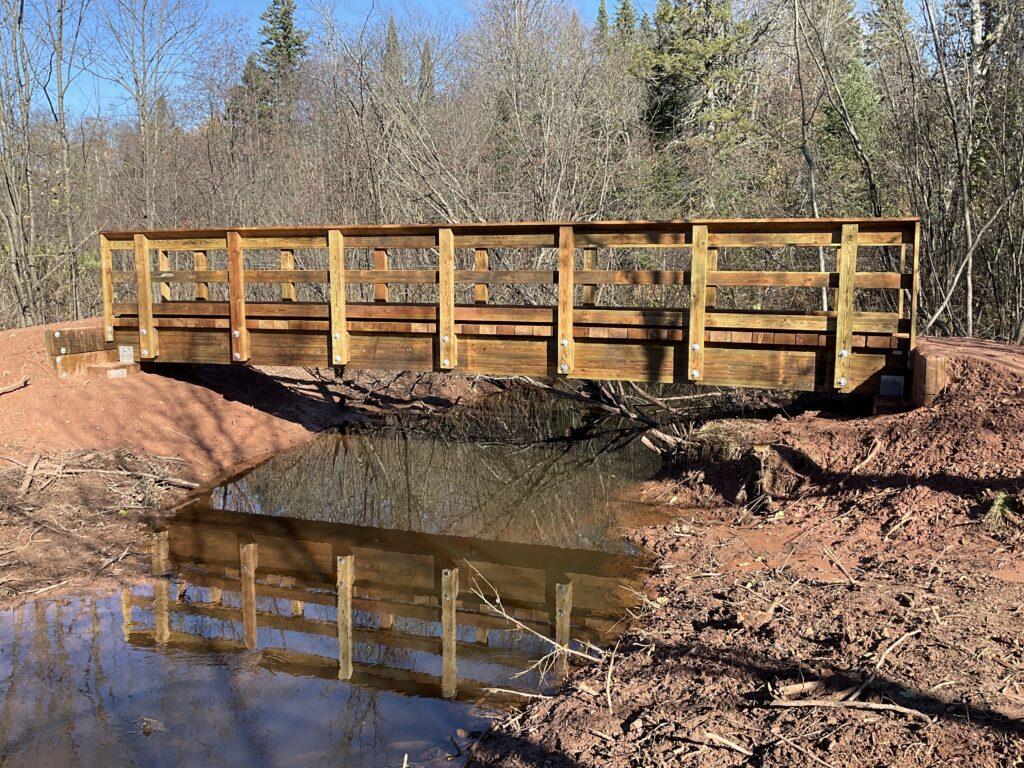
Bush Creek Bridge
Ottawa National Forest, Upper Peninsula
Deep in the Ottawa National Forest, a stretch of nearly 10 miles of trail winds through the
western Upper Peninsula without a single road crossing, one of the most remote and rugged sections of the North Country Trail in Michigan. For years, a crossing over Bush Creek stood as the missing link in that wilderness experience. The Michigan Trail Fund (MTG) made it possible to close that gap for good.
The Michigan Trail Fund initially funded the design and engineering for a 31-foot bridge over
Bush Creek and was able to successfully step in again to fund more than half of the
construction costs, bringing the project across the finish line. The result is a handcrafted
wooden glulam bridge resting on helical pier abutments, an elegant, durable structure built to last in one of Michigan’s most demanding environments. With this bridge in place, hikers can now travel nearly 10 continuous miles of backcountry trail without encountering a road, a rare and remarkable experience that defines what the North Country Trail is meant to be.
Total Investment: $104,000
Partners: North Country Trail Association, NCTA Peter Wolfe Chapter, Ottawa National Forest, Upper Peninsula Engineers and Architects, Rock Solid Trail Contracting
Volunteers: 3
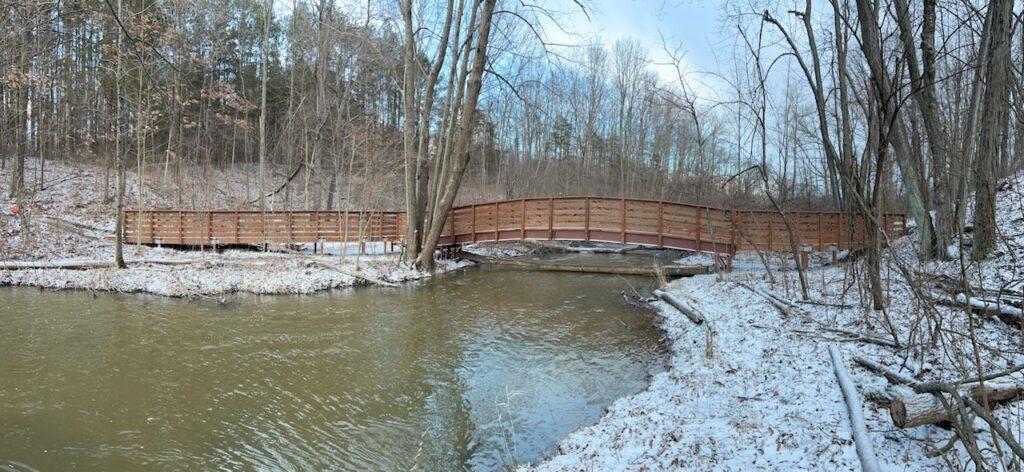
East Branch St. Joseph River Bridge & Boardwalk
Lost Nation State Game Area, Southern Michigan
The North Country Trail through southern Michigan’s Lost Nation State Game Area held
enormous potential but a crossing of the East Branch St. Joseph River stood between trail
users and a seamless 2.2-mile trail experience. With support from the Michigan Trail Fund, that
crossing is now a reality.
Construction of a 38-foot bridge over the East Branch St. Joseph River, flanked by 54 feet of boardwalk on one side and 24 feet on the other, transformed a disconnected stretch of trail into a continuous, accessible corridor through one of southern Michigan’s most scenic game areas. Approximately 20 volunteers joined partners from the North Country Trail Association, the NCTA Chief Baw Beese Chapter, and the Michigan DNR to bring the project to life.
What makes this project stand out is its innovative approach to construction. The structure uses Custom Manufacturing’s unique modular pan footings for both the bridge abutments and
boardwalk a system that requires minimal ground disturbance, with workers simply leveling the pans rather than excavating or driving posts. It’s a smarter, more sustainable way to build in sensitive natural areas, and a model worth repeating.
Total Investment: $56,300
Partners: North Country Trail Association, NCTA Chief Baw Beese Chapter, Michigan DNR,
Custom Manufacturing
Volunteers: Approximately 20
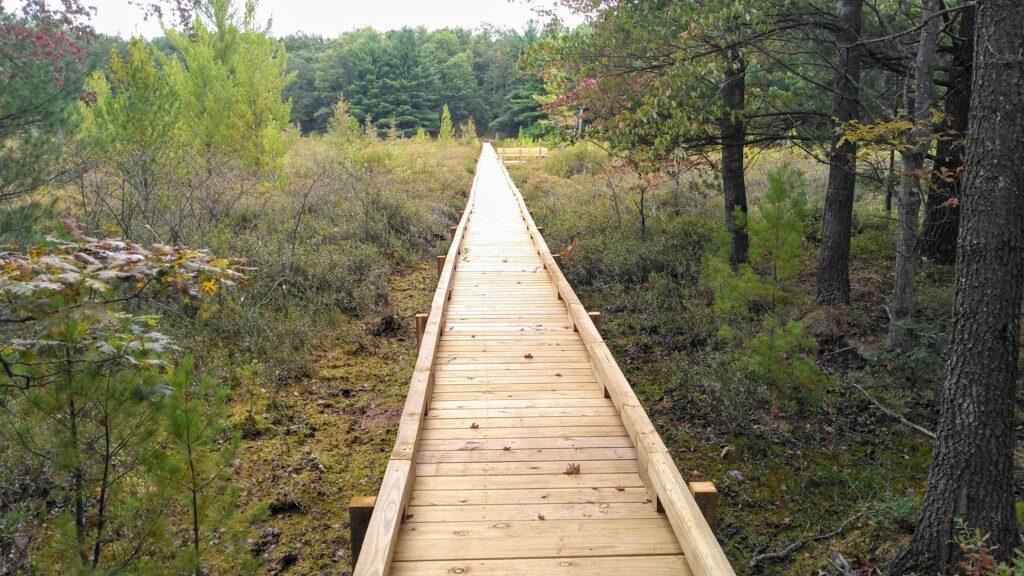
Echo Drive Boardwalk Reroute
Western Michigan
For trail users navigating a key section of the North Country Trail in western Michigan, a ¾-mile
stretch of road walk was more than an inconvenience; it was a safety hazard that interrupted
one of the region’s most beloved trail experiences. Thanks to the Michigan Trail Fund and a
dedicated coalition of partners, hikers will never have to make that road walk again.
Over 600 feet of new boardwalk made it possible to reroute 3 full miles of trail off the road and
into the natural landscape where it belongs, eliminating the dangerous segment entirely and
delivering a dramatically better experience for everyone who walks this corridor.
The project’s success started with smart planning. U.S. Forest Service staff conducted a
feasibility study and identified a solution that would minimize environmental impact through a
sensitive wetland area; Custom Manufacturing’s modular foot pans, which sit on top of the
ground rather than requiring posts to be dug in. The result is a boardwalk that threads through
the wetland with a minimal footprint, preserving the very environment that makes the trail worth walking.
Thirty volunteers helped make it happen alongside partners from the North Country Trail
Association, the NCTA Western Michigan Chapter, the U.S. Forest Service, and the Fremont
Community Foundation.
Total Investment: $47,500
Partners: North Country Trail Association, NCTA Western Michigan Chapter, U.S. Forest
Service, Fremont Community Foundation
Volunteers: ~30
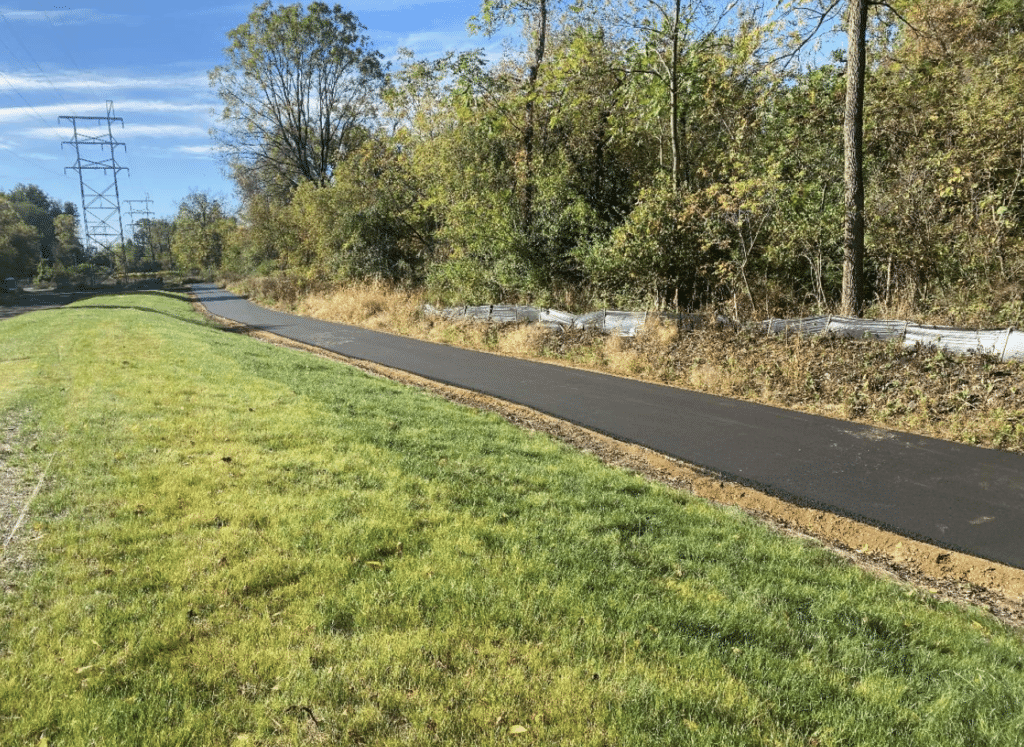
Mike Levine Lakelands Trail Extension Jackson County Parks
In Jackson County, a new 2.8-mile trail now links the community’s trail network to a much larger vision. Beginning at Monroe Avenue in the City of Jackson, the trail travels north along the Grand River, passes beneath I-94, and follows Lansing Avenue to Parnall Road — where it turns east to connect with the existing Mike Levine Lakelands Trail State Park. The Michigan Trail Fund [helped make this connection possible / describe MTF’s role once confirmed].
This short but critical link closes a gap in Jackson County’s trail system and, with its completion, creates a contiguous 110-mile trail stretching from Keeley Park all the way to Richmond, Michigan. The new trail directly ties into the Mike Levine Lakelands Trail State Park, the Huron Valley Trail, Island Lake Pathway, Michigan Air Line Trail, West Bloomfield Trail, Clinton River Trail, and the Macomb Orchard Trail — knitting together a regional network that spans the width of southern Michigan.
The project is also part of a much larger story. It forms a piece of the Route 1 Great Lake-to-Lake Trail, a roughly 275-mile route across the state from South Haven to Port Huron, and the statewide Michigan Iron Belle Trail, which extends more than 2,000 miles from the far western tip of the Upper Peninsula to Belle Isle in Detroit. With this connection in place, a local trail in Jackson County now plays a role in one of the most ambitious trail systems in the country.
The trail is now operated as a Jackson County Park.
Partners: Jackson County Department of Transportation, Michigan Department of Transportation, Michigan Department of Natural Resources, City of Jackson, Blackman Township, Consumers Energy
Deepwater Connector Acme Township, Grand Traverse Region
Just outside Traverse City, the US-31/M-72 corridor has long stood as a gap in the region’s trail network, a stretch where neighborhoods, businesses, and parks sat close together but disconnected, separated by a busy road corridor with no safe non-motorized route through. The Deepwater Connector closes that gap, linking the surrounding community directly into the region’s more than 100 miles of connected trails. The Michigan Trail Fund made it possible to get the project off the ground.
The Michigan Trail Fund’s $100,000 grant served as the critical lead investment, giving TART Trails and Acme Township the credibility and momentum to launch a broader community fundraising campaign. That campaign including a successful crowdfunding effort that brought in 22 first-time donors ultimately leveraged more than $305,000 in additional funding, with 104 donors supporting the project in total. The fundraising success also allowed TART Trails and Acme Township to establish a maintenance set-aside, ensuring the trail is cared for well into the future.
With the Deepwater Connector complete, residents and visitors now have safe non-motorized access linking neighborhoods, businesses, and parks to the region’s broader trail system turning a fragmented corridor into a connected part of the Grand Traverse area’s trail network.
Total Investment: $100,000 MTF grant leveraged more than $305,000 in additional funding
Partners: TART Trails, Acme Township Donors: 104, including 22 first-time donors